


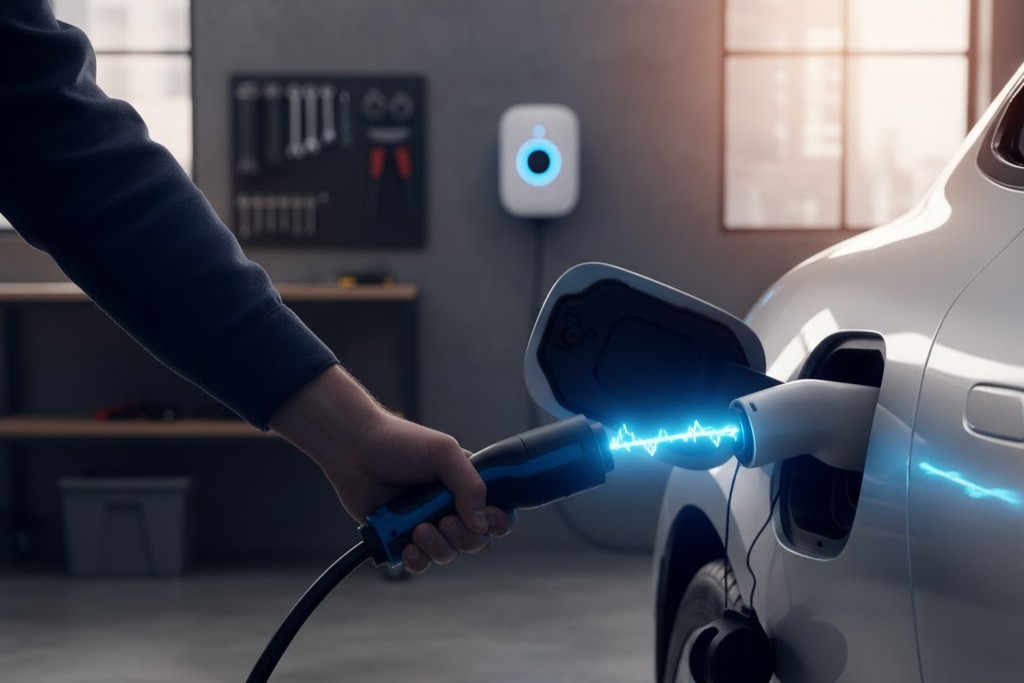
Electric vehicle charging cables are a core component of every EV setup, powering up your vehicle efficiently and safely. But not all EV charging cable types are created equal. Understanding the differences in connectors, power ratings, and compatibility helps professionals like you make smarter decisions for both residential and commercial installations.
This guide walks you through the main EV charging cable types, UK-specific standards, power ratings, and tips on choosing the best EV charging cable for your needs.
Table of Contents
- What Are Electric Vehicle Charging Cables?
- Common EV Charging Cable Types
- EV Charging Cable Types UK
- Power Ratings and Charging Speeds
- Choosing the Best EV Charging Cable
- Frequently Asked Questions
- Conclusion
What Are Electric Vehicle Charging Cables?

Electric vehicle charging cables connect your EV to a power source, transferring energy from the grid to the car’s battery. These cables vary in terms of charging speed, plug type, and compatibility with different EV models and charge points.
For installers and suppliers, choosing the right cable type not only improves performance but also ensures compliance with UK standards and customer expectations.
Common EV Charging Cable Types
Type 1 EV Charging Cable
- Single-phase connector, commonly found on older models and US/Japanese imports.
- Max power output: typically up to 7.4kW
- Locking mechanism ensures safe plug-in
Type 2 EV Charging Cable
- Most common in the UK and Europe
- Supports single-phase and three-phase charging
- Compatible with public and home charge points
- Max output: up to 22kW on AC chargers
Type 2 cables dominate the EV charging cable types UK market, thanks to universal compatibility and government-endorsed infrastructure.
CCS and CHAdeMO (Rapid Charging)
- CCS (Combined Charging System): Europe’s rapid charging standard. Supports both AC and DC with two additional power pins. DC fast charging up to 350kW.
- CHAdeMO: Favoured by Nissan and a few others. DC charging up to 50kW. Mostly being phased out in Europe.
EV Charging Cable Types UK
In the UK, the Type 2 cable is the standard for both home and public AC charging. All new EVs sold in the UK come with a Type 2 socket or are compatible with it. Installers are advised to stock and recommend Type 2 for maximum flexibility and compatibility.
Additionally, professionals should be aware of tethered vs untethered charging units:
- Tethered units come with a built-in cable (great for regular use)
- Untethered units allow users to plug in their own cable (ideal for multi-car households or public use)
Power Ratings and Charging Speeds
The power rating of an electric vehicle charging cable directly affects how fast the EV charges. Power ratings are typically based on kilowatts (kW) and depend on whether the cable is single-phase or three-phase.
Cable Type | Voltage | Amps | Max Power | Charging Time (Typical EV) |
Type 1 (Single) | 230V | 32A | 7.4kW | 4–8 hours |
Type 2 (Single) | 230V | 32A | 7.4kW | 4–8 hours |
Type 2 (Three-phase) | 400V | 32A | 22kW | 1.5–3 hours |
CCS (DC Rapid) | 400V+ | 500A | 50–350kW | 20–60 minutes |
Always match your cable’s rating to the vehicle’s onboard charger and the capacity of the power supply. Overrating a cable won’t damage anything but adds unnecessary cost. Underrating it, though, slows charging.
Choosing the Best EV Charging Cable
When selecting the best EV charging cable, consider the following:
- Connector Type: Type 2 is the UK standard. Ensure compatibility with both the vehicle and charge point.
- Power Rating: Match the cable’s amp rating and phase to the charge point and vehicle specs.
- Cable Length: 5 metres is standard, but longer cables (up to 10 metres) are available for added flexibility.
- Weather Resistance: Look for IP-rated cables for outdoor use.
- Storage and Portability: Spiral cables are easier to store but limit range. Straight cables offer full reach but require careful handling.
Bonus tip for installers: keep a stock of universal Type 2-to-Type 2 cables rated at 22kW for broad compatibility with public charge points and fast AC charging.
Frequently Asked Questions
1. Can I use a Type 2 cable on any electric vehicle?
Most EVs sold in the UK and Europe are either equipped with a Type 2 socket or come with an adapter. Type 2 cables are widely compatible, especially for AC charging at public stations and home chargers. However, always confirm your vehicle’s socket type before purchasing.
2. What’s the difference between tethered and untethered EV chargers?
- Tethered chargers come with a fixed cable attached, which is great for convenience and everyday use at home.
- Untethered chargers require you to use your own cable, offering more flexibility, especially in shared or public charging scenarios.
3. Are all Type 2 cables capable of 22kW charging?
Not necessarily. While Type 2 connectors support up to 22kW AC charging, the cable must be three-phase and rated for 32 amps to handle that power. Always check the cable’s specifications before use.
4. Can I use a higher-rated EV charging cable than my vehicle requires?
Yes. Using a cable with a higher power rating than your EV or charge point will not harm anything. However, charging will still be limited to the maximum capacity of your vehicle’s onboard charger.
5. What’s the best cable length for daily use?
A 5-metre cable is the standard and works well for most home and workplace setups. Opt for a longer cable (7–10 metres) if your charging point is far from your parking space, but be aware of handling and storage needs.
6. Do EV charging cables work in the rain?
Yes. As long as they’re IP-rated for outdoor use. Most quality EV charging cables are designed to be weatherproof and safe to use in various weather conditions.
Conclusion
Choosing the right electric vehicle charging cables improves charging performance, protects your hardware, and ensures compliance with UK standards. With a solid understanding of EV charging cable types, power ratings, and UK requirements, professionals can confidently recommend and install the best EV charging cable for any scenario.
At Batt Cables, we supply a wide range of high-quality EV charging cables built to meet current standards and future demands.
